


What to Look for in an Air Purifier for Large Rooms
An air purifier for large rooms is one of the most effective things you can do for your home's air quality. Whether you're tackling allergens, reducing odors, cutting down on dust, or simply breathing cleaner air day to day, a purifier sized correctly for your space will make a noticeable difference.
Knowing how to choose an air purifier for a large room comes down to a handful of specifications and features working together. Here’s everything worth understanding before you choose yours.
Clean Air Delivery Rate and Recommended Range
CADR (Clean Air Delivery Rate) is the number that matters most. It measures how much clean air a purifier delivers per hour, expressed in cubic feet per minute (CFM) or cubic metres per hour (m³/h).
The higher the CADR, the more air the unit processes.
As a general rule, the Association of Home Appliance Manufacturers recommends that a purifier's CADR should be at least two-thirds of your room's square footage. For genuinely large or open-plan spaces, that typically means looking for a CADR in the region of 300–400 CFM (roughly 500–680 m³/h) to keep pace with the room.
But CADR alone doesn't tell you the whole story. Most CADR figures assume the air in your room is already well-mixed and circulating evenly. In practice, it isn't. Pollutants settle in corners and around furniture, and pool in spots that get little natural airflow.
Even Purification is the measure that addresses this gap. Rather than just measuring how much clean air a purifier outputs, it measures how far that air travels, and how evenly it reaches the full room.
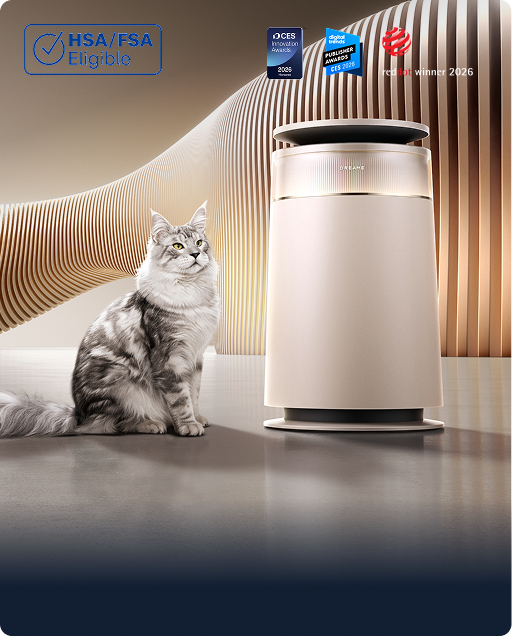
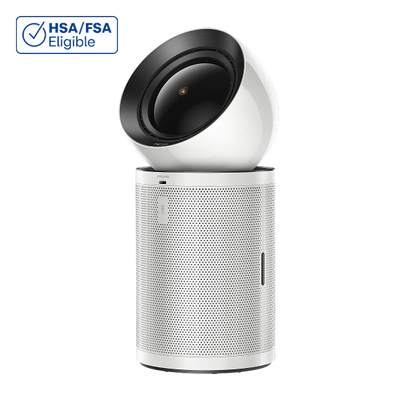
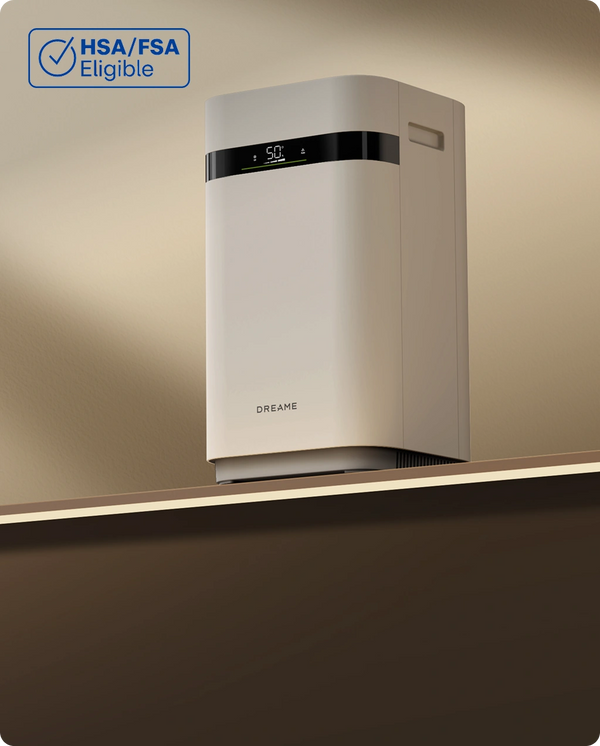
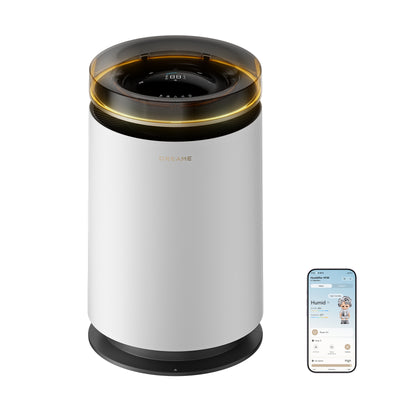
The Dreame AirPursue™ PM20 uses Dualflow Directional Airflow to project clean air up to 10m (33 ft.) across the room, rather than exhausting it straight upward. The result is even purification coverage across up to 1,690 sq. ft. (157m²), and clean air distributed into corners, around furniture, and to the far side of open-plan spaces.
Air Changes Per Hour
This is where ACH comes in. ACH (air changes per hour) tells you how many times a purifier can cycle through the full volume of air in your room within an hour.
ASHRAE (the American Society of Heating, Refrigerating, and Air-Conditioning Engineers) recommends a minimum of 4–5 ACH for occupied living spaces. Below that, pollutants build up faster than the purifier can remove them.
ACH isn't a figure you'll usually find on a product listing, but it's straightforward to work out. If you want to check it yourself:
- Find your room volume — multiply floor area (sq. ft.) by ceiling height (ft.).
- Note the CADR in CFM (divide m³/h by 1.699 to convert).
- Calculate ACH — multiply CFM by 60, then divide by room volume.
Most coverage figures on packaging assume a standard 8–9 ft ceiling. If your room has high or vaulted ceilings, or a particularly open layout, you'll want to choose a purifier with more headroom in the spec than the stated coverage area suggests.
Filter Type and Depth
For particle removal in a large room, H13*-grade filter media is a solid benchmark; it captures particles down to 0.3 microns, covering dust, pollen, pet dander, and fine smoke.
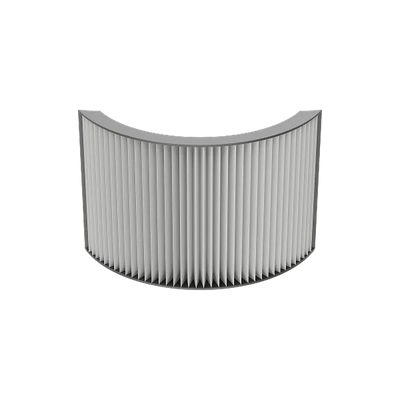
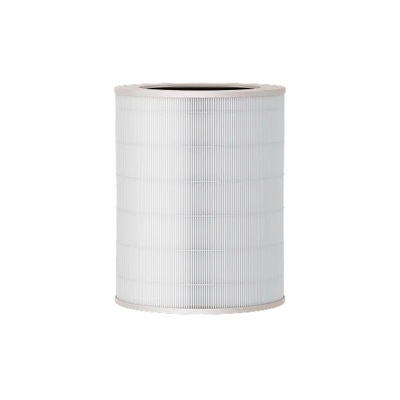
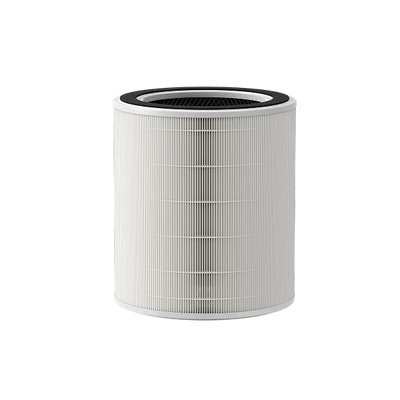
Dreame's large-room air purifiers use a High-Efficiency Composite Filter rather than traditional HEPA. That's a deliberate design choice: composite filter media creates less airflow resistance, which means higher CADR for the same unit size. The air gets cleaned more frequently across the room, rather than passing more slowly through denser media.
In a big room, filtration needs to cover more than just particles. Dust, allergens, odors, and gases all build up differently and need targeting at different stages. The PM20's four-layer system works in sequence:
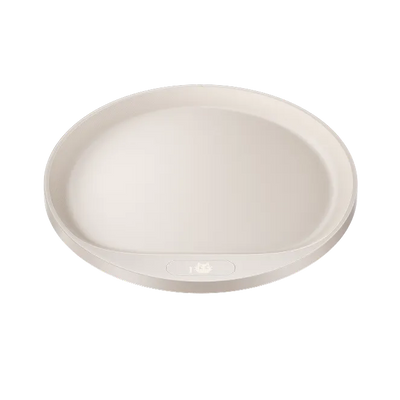
- Pre-filter: catches hair, large debris, and dust before they reach the main filter. Washable, so no replacement needed.
- High-efficiency composite filter (H13* grade): captures fine particles like allergens, pollen, mold spores, and smoke down to 0.3 microns.
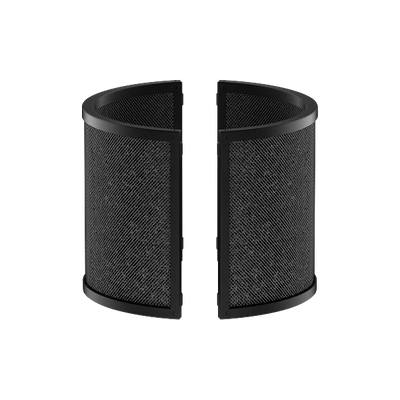
- Activated carbon layer: absorbs gases and odors, including TVOCs, toluene, and formaldehyde (CTC >80%).
- Formaldehyde-cata filter: decomposes formaldehyde into CO2 and water. Doesn't need replacing.
Smart Air Purifier Features That Matter in Larger Spaces
In a large room, the features that do the most work are the ones that keep the purifier performing without constant input from you. You won't always notice the air quality changing until it's already been building for a while — here's what to prioritize. And once you've chosen, where you place your purifier matters just as much as the spec.
- Air quality sensor and auto mode. A good sensor suite measures PM1, PM2.5, PM10, formaldehyde, and TVOCs in real time. Auto mode reads those levels and adjusts fan speed accordingly, ramping up when cooking smoke drifts in from the kitchen, dialing back once the air clears. The PM20 carries 7 sensors and responds without any manual input from you.
- Noise level (dBA). Living rooms and shared spaces are social environments. A purifier running loudly competes with conversation and TV. At 32 dB(A) on Sleep Mode, the PM20 sits comfortably below the ambient noise level of most homes.
- Wi-Fi connectivity and app control. In a room you’re not always in, being able to check air quality and adjust settings remotely makes a real difference. The Dreamehome app shows live sensor readings, lets you set schedules, and logs air quality history, so you can see exactly what the air in your room has been doing while you've been elsewhere.
Verification and Testing
When comparing air purifiers, lab testing and third-party verification are good signals that a product's performance claims have been put to the test, not just stated on a spec sheet.
Dreame Air Purifiers are lab-tested and third-party verified, so the CADR figures, coverage estimates, and filtration ratings you see reflect real, measured performance.
It's also worth checking whether a purifier includes an ionizer. Some purifiers add an ionizer as an extra purification layer, but ionizers can produce trace ozone as a by-product, making them a less ideal choice for continuous use in occupied living spaces. Filtration-based purifiers avoid this trade-off entirely.
How Much Does It Cost to Run an Air Purifier in a Large Room?
Air purifier running costs break into two clear lines: electricity and filters.
Electricity. The PM20 runs at 33W in standard operation. Running at that draw for 12 hours a day uses less than 1 kWh per day. At the US average electricity rate of around $0.16/kWh, that works out to roughly $0.15 a day (or less than $5 a month for continuous daily use).
A better efficiency indicator than wattage alone is the CADR-to-power ratio: how much clean air a purifier delivers per watt used. In a large room where the unit runs for long stretches, that ratio matters more than peak wattage.
Filter replacement. This is where the longer-term cost picture becomes clearer:
- High-efficiency composite filter (PM20): replacement recommended every 16–24 months based on daily use.
- Activated carbon filter (PM20): replacement recommended every 6–12 months.
- Formaldehyde-cata filter (PM20): no replacement needed; it decomposes formaldehyde rather than collecting it.
- Pre-filter: doesn't need replacing. Rinse or vacuum every 2–4 weeks.
Pre-filter maintenance is worth taking seriously. A clogged pre-filter forces the composite filter to work harder, shortening its lifespan and gradually reducing CADR. Keeping it clean is the simplest way to protect your investment.
The Dreamehome app tracks filter usage across all layers and sends a replacement alert when it's time — so you're not relying on memory or a calendar.